

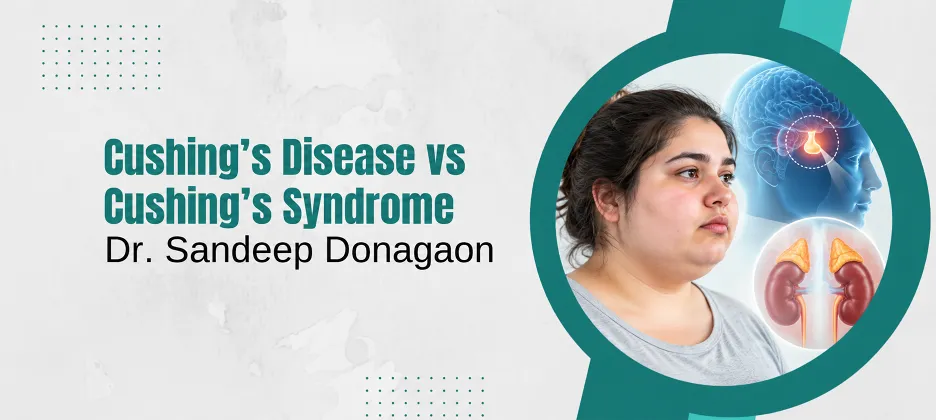
The names sound almost identical, and they’re often used interchangeably, even in search results and waiting rooms. But Cushing’s disease and Cushing’s syndrome are not the same thing, and the difference matters because it decides which tests you need and which treatment will actually work. In short, one is a broad condition and the other is one specific cause of it.
Dr. Sandeep Donagaon, an endocrinologist in Hubli Dharwad at Dr. Sandeep’s Superspeciality Centre, explains that Cushing’s syndrome is the umbrella term for the effects of prolonged high cortisol in the body, while Cushing’s disease is a specific type, caused by a small tumour in the pituitary gland that overproduces the hormone ACTH.
“Every case of Cushing’s disease is Cushing’s syndrome, but not every case of Cushing’s syndrome is Cushing’s disease. That one distinction decides whether we’re looking at the pituitary, the adrenal glands, or a medication the patient has been taking, and the treatment is completely different for each.”
— Dr. Sandeep Donagaon, Endocrinologist, Dr. Sandeep’s Superspeciality Centre, Hubli
What Is Cushing’s Syndrome?
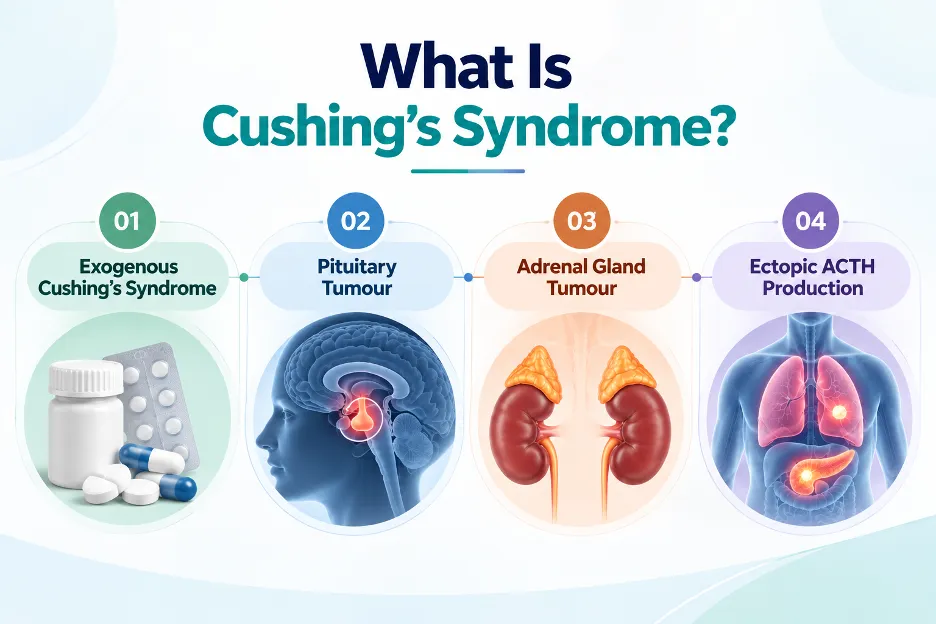
Cushing’s syndrome is the name for the collection of symptoms and health changes that develop when the body is exposed to too much cortisol, the stress hormone, for a long time. Cortisol helps regulate blood sugar, blood pressure, metabolism, and the immune response, so when levels stay high, nearly every system is affected.
Exogenous Cushing’s Syndrome:
This is the most common cause overall, and it comes from outside the body. Long-term use of steroid medicines such as prednisolone, often prescribed for asthma, arthritis, or autoimmune conditions, can raise cortisol-like activity enough to cause the full syndrome.
Pituitary Tumour:
A small, usually benign tumour in the pituitary gland releases excess ACTH, which signals the adrenal glands to make too much cortisol. This specific cause is Cushing’s disease.
Adrenal Gland Tumour:
A growth in one of the adrenal glands can produce cortisol on its own, regardless of what the pituitary is signalling. Patients with this pattern may need evaluation for adrenal gland tumours.
Ectopic ACTH Production:
Rarely, a tumour elsewhere in the body, such as in the lung or pancreas, produces ACTH and drives cortisol upward.
What Is Cushing’s Disease?
Cushing’s disease is one specific cause of Cushing’s syndrome: a pituitary adenoma that makes too much ACTH. It is the most common cause of endogenous (internally produced) Cushing’s syndrome, and it is more frequently diagnosed in women than in men, usually between the ages of 25 and 50.
The Source Is the Pituitary:
The tumour sits in the pituitary gland at the base of the brain and keeps sending out ACTH, which keeps the adrenal glands overproducing cortisol.
The Tumour Is Usually Small and Benign:
Most of these adenomas are tiny, often only a few millimetres, which is exactly why they can be difficult to see on a scan.
It Needs a Pituitary-Directed Treatment:
Because the problem starts in the pituitary, treating the adrenal glands alone doesn’t fix the cause. For more on how doctors tell a benign growth from a dangerous one, this guide on adenoma vs adenocarcinoma is a useful read.
Cushing’s Disease vs Cushing’s Syndrome: Key Differences
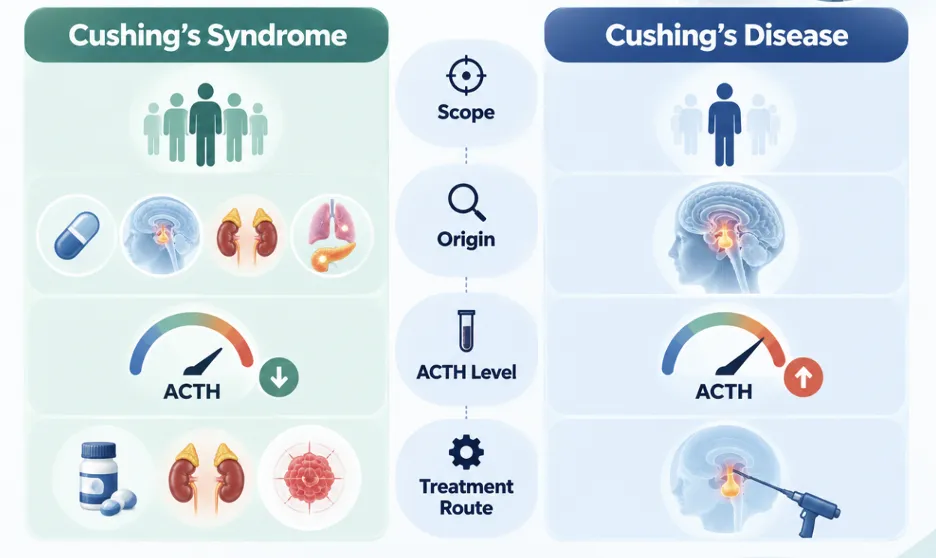
Seeing the two side by side makes the distinction much easier to remember.
Scope: Cushing’s syndrome is the broad condition of excess cortisol from any cause. Cushing’s disease is one narrow cause within it.
Origin: Syndrome can come from medication, the pituitary, the adrenal glands, or a tumour elsewhere. Disease always comes from a pituitary adenoma.
ACTH Level: In Cushing’s disease, ACTH is high or inappropriately normal. In an adrenal tumour or steroid-induced cases, ACTH is typically low, because the body is already flooded with cortisol.
Treatment Route: Disease is usually treated with pituitary surgery. Syndrome treatment depends on the source, whether that means tapering a steroid, removing an adrenal tumour, or treating a tumour elsewhere.
Dr. Sandeep Donagaon notes:
“Patients often hear one word and assume the other. What I tell them is simple: the symptoms look alike, but the cause is what we treat, and finding that cause is the real work of the diagnosis.”
Symptoms Common to Both Conditions
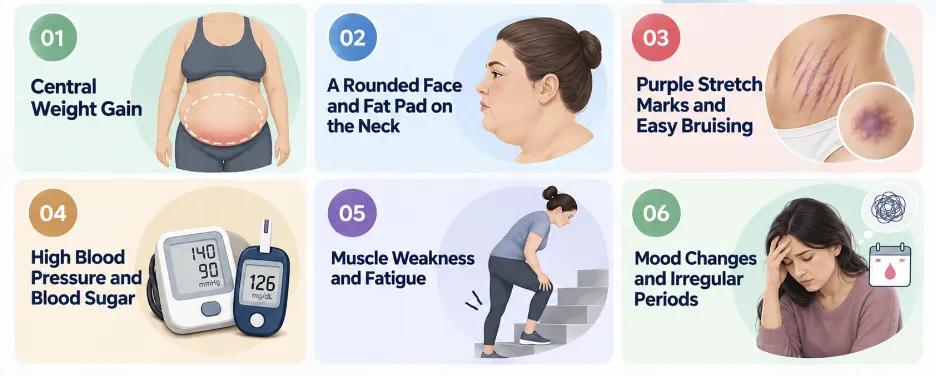
Because both involve excess cortisol, the symptoms overlap almost completely, which is why testing is the only reliable way to tell them apart.
Central Weight Gain: Fat builds up around the abdomen, face, and upper back while the arms and legs stay relatively thin. This pattern is easy to mistake for ordinary weight gain, which is why a proper obesity and weight-loss evaluation should look at hormones, not just calories.
A Rounded Face and Fat Pad on the Neck: Often called a “moon face” and “buffalo hump,” these changes tend to develop gradually and are easy to miss in daily life.
Purple Stretch Marks and Easy Bruising: Wide purple-red stretch marks on the abdomen, thighs, or arms, along with thin skin that bruises easily, are strong clues.
High Blood Pressure and Blood Sugar: Excess cortisol raises both, and persistent, hard-to-control readings may point to an underlying hormonal cause, sometimes first picked up during diabetes care.
Muscle Weakness and Fatigue: Difficulty climbing stairs or standing up from a chair is common because cortisol breaks down muscle protein over time.
Mood Changes and Irregular Periods: Anxiety, low mood, and irritability are common, and women may notice irregular or absent periods and increased facial hair.
How Doctors Tell Them Apart
Diagnosis happens in two stages: first confirming that cortisol is truly too high, then finding where it’s coming from.
- Step 1: Confirm Excess Cortisol: Tests such as a late-night salivary cortisol, a 24-hour urinary free cortisol, or an overnight dexamethasone suppression test check whether cortisol is behaving abnormally. More than one test is usually needed, because results can fluctuate.
- Step 2: Check ACTH: A blood ACTH level helps separate ACTH-dependent causes, like a pituitary adenoma, from ACTH-independent causes, like an adrenal tumour.
- Step 3: Imaging: An MRI of the pituitary looks for an adenoma, while a CT scan of the adrenal glands looks for adrenal masses. Because pituitary tumours can be very small, additional specialised testing is sometimes needed.
- Step 4: Review of Medications: A careful history of steroid use, including tablets, injections, inhalers, and even some creams or traditional remedies, is essential before any scan is ordered.
According to the National Institute of Diabetes and Digestive and Kidney Diseases, Cushing’s syndrome is diagnosed through a combination of clinical findings and cortisol testing rather than a single test, which is why a thorough specialist evaluation matters.
Treatment: What Changes Depending on the Cause

Because the causes differ, treatment is never one-size-fits-all.
Cushing’s Disease: The usual first-line treatment is surgical removal of the pituitary adenoma, often through the nose. If surgery isn’t possible or doesn’t fully work, medication or radiation may follow.
Adrenal Tumour: Removing the affected adrenal gland is usually the treatment, followed by temporary hormone replacement while the other gland recovers.
Steroid-Induced Cases: The medication is gradually reduced under supervision. Stopping steroids suddenly can be dangerous, so this must never be done without medical guidance.
Medical Therapy: Medicines that block cortisol production or its effects can be used to control symptoms before surgery or when surgery isn’t an option.
Managing the Fallout: High cortisol often leaves behind complications, including weak bones, so many patients also need bone density care alongside the main treatment.
“Cushing’s is easy to miss because each symptom on its own looks ordinary. It’s the pattern, the weight, the skin, the blood pressure, the mood, that tells the story, and that’s what we look for.”
— Dr. Sandeep Donagaon
Conclusion
Cushing’s syndrome is the broad condition of too much cortisol, and Cushing’s disease is one specific cause of it, a pituitary tumour overproducing ACTH. The symptoms look the same, but the source decides the treatment, which is why accurate testing matters more than the label. With the right diagnosis, both can be managed effectively, and early evaluation gives the best chance of preventing long-term complications.
Frequently Asked Questions
1. Is Cushing’s disease the same as Cushing’s syndrome?
2. What is the most common cause of Cushing’s syndrome?
3. Can Cushing’s syndrome be cured?
4. How is Cushing’s disease diagnosed?
5. When should I see an endocrinologist for Cushing’s symptoms?
References
- Mayo Clinic — Cushing Syndrome: https://www.mayoclinic.org/diseases-conditions/cushing-syndrome/symptoms-causes/syc-20351310
- National Institute of Diabetes and Digestive and Kidney Diseases — Cushing’s Syndrome: https://www.niddk.nih.gov/health-information/endocrine-diseases/cushings-syndrome
Disclaimer:
This blog is for educational purposes only and is not a substitute for professional medical advice. Please consult a qualified healthcare professional for guidance specific to your circumstances.