

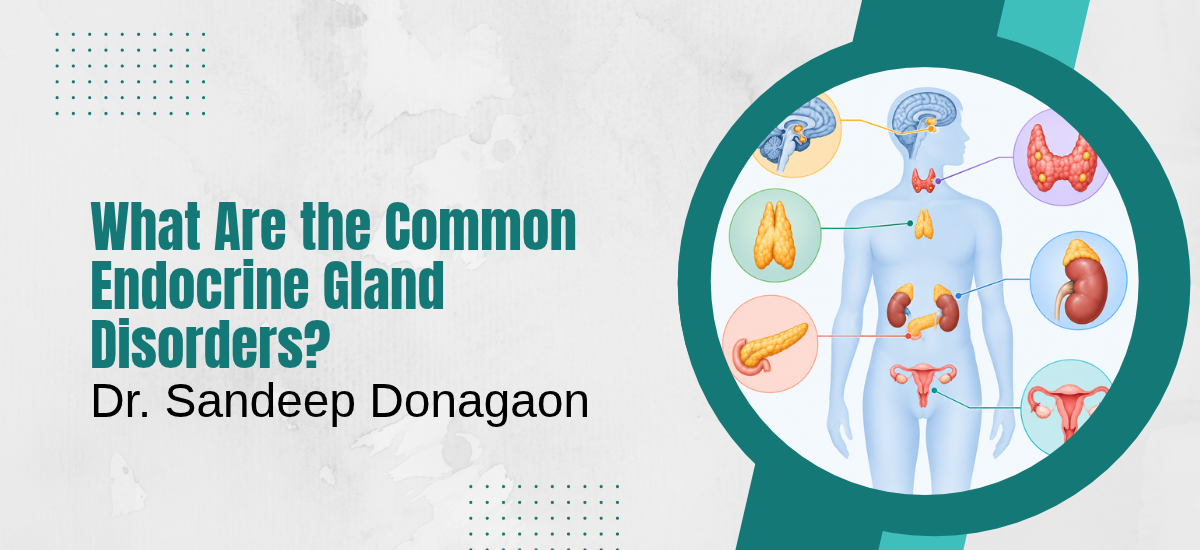
Endocrine gland disorders start when a gland produces too much hormone, too little, or when the body doesn’t respond to it the way it should. The usual trouble spots are the thyroid, pancreas, pituitary, adrenal and parathyroid glands, along with the ovaries and testes. The tricky part is that many endocrine disorders look like everyday life. Tiredness, a few extra kilos, a low mood. Most people blame work and carry on. A blood test for the right hormone usually settles the question quickly.
According to Dr. Sandeep Donagaon, Endocrinologist at Dr. Sandeep’s Superspeciality Centre, Hubli, “People often treat endocrine disorders as a single condition, but each gland has its own set of problems. The symptoms overlap a great deal, so tiredness or weight change alone can’t tell us which hormone is involved. A blood test for that hormone is the first step. Once the cause is clear, the treatment plan follows from it.”
Which Glands Are Involved in Endocrine Gland Disorders?
Several major glands make up the endocrine system, each with a specific role.
- The thyroid decides how fast the body runs. An underactive one leaves you slow and tired, and an overactive one leaves you restless with a racing heart. Weight tends to shift either way.
- The pancreas looks after blood sugar. It makes insulin. When there’s too little, or the body won’t listen to it, diabetes is the result.
- The pituitary gives the other glands their orders. It’s only the size of a pea. One problem there can upset several hormones together.
- The adrenal glands handle stress hormones. Too much cortisol causes Cushing’s syndrome. Too little causes Addison’s disease.
- The parathyroids, ovaries and testes add to the list. The parathyroids control calcium and bone health. The ovaries and testes are behind conditions like PCOS and low testosterone, and these usually come under hormonal treatment.
How Do Endocrine Disorders Develop?
Most of them follow one of a few patterns, and the pattern shapes the treatment.
- Sometimes a gland produces too much hormone. Hyperthyroidism is the classic case, with hormone levels well above normal.
- Sometimes it produces too less. In adrenal insufficiency, for instance, the body simply runs short.
- Sometimes the body stops responding properly. Insulin resistance works this way, and it often appears years before type 2 diabetes.
- Sometimes the immune system is the cause. Hashimoto’s and Graves’ disease both target the thyroid. One slows it down, the other speeds it up.
- Sometimes it’s a lump. Even a harmless growth in or near a gland can throw hormones off balance. You won’t feel it, but the blood test will show it.
How Are Endocrine Gland Disorders Diagnosed and Treated?
Endocrine gland disorders are usually diagnosed through a combination of medical history, physical examination, blood tests to measure hormone levels, and sometimes urine tests or imaging studies. The specific tests depend on the gland involved and the symptoms a person experiences.
Treatment varies according to the underlying condition and may include hormone replacement therapy, medicines to control excess hormone production, lifestyle changes, or surgery in selected cases. Early diagnosis and regular monitoring help manage symptoms, prevent complications, and maintain hormonal balance.
What Determines the Treatment for Endocrine Gland Disorders?
No two cases get quite the same plan.
- Treatment depends on the hormone involved . Low levels may need hormone replacement.High levels are brought down by slowing the gland’s output.
- The cause matters just as much. An autoimmune condition, a growth and the side effect of a medicine each need different handling.
- Age plays a part. Children, older adults and pregnant women all have different needs. Thyroid problems during pregnancy is a good example, since it needs closer checks and dose changes.
- Other illnesses count too. Diabetes, heart trouble or kidney problems can rule some medicines out.
- Then comes follow-up. Repeat blood tests show whether the treatment is working. If it isn’t, the plan changes.
Key Takeaways
- Endocrine gland disorders mean a hormone is too high, too low, or being ignored by the body.
- The usual glands involved are the thyroid, pancreas, pituitary, adrenals and parathyroids, plus the ovaries and testes.
- Tiredness and weight change fit many conditions, so a blood test is what pinpoints the cause.
- Treatment depends on the gland, the cause, your age and any other illness.
- Most of these conditions are long term, so regular follow-up is part of the deal.
Could hormones be behind your symptoms? Speak to a specialist.
Frequently Asked Questions
Which endocrine disorders are most common?
Diabetes and thyroid problems are among those seen most often.
What are the early signs of endocrine gland disorders?
Constant tiredness, weight changes, low mood and irregular periods are often the first signs.
How are endocrine disorders diagnosed?
A blood test checks hormone levels. Scans are added only if needed.
Can endocrine gland disorders be managed?
Often, yes. Medicines and regular check-ups keep many of them under control.
References
- NIDDK, Endocrine Diseases: https://www.niddk.nih.gov/health-information/endocrine-diseases
- MedlinePlus, Endocrine Diseases: https://medlineplus.gov/endocrinediseases.html
Disclaimer:
This blog is for educational purposes only and is not a substitute for professional medical advice. Please consult a qualified healthcare professional for guidance specific to your circumstances.